Every year, global flight delays cost the aviation industry tens of billions of dollars. Ground operations account for a chunk of these expensive hold-ups. When an airport handles tens of millions of passengers a year, a single disrupted flight can trigger a domino effect that ruins the daily schedule. To prevent these cascading delays, airport leaders rely on a centralised hub to monitor and manage every moving part. Setting up an Airport Operations Centre or Airport Predictive Operations Centre (APOC) stops this chain reaction. A fully connected APOC Command Centre gives your teams the exact tools they need to protect flight schedules and prevent costly bottlenecks.
According to the International Air Transport Association (IATA), global passenger numbers are projected to double by the year 2040. Airports cannot simply build more runways and terminals to handle this volume. They must become far more efficient with the physical space they already have. Efficiency requires perfect coordination.
Every day, baggage handling, gate assignments, security checkpoints, and ground operations must align flawlessly. When communication breaks down, passengers miss connections, and airlines burn unnecessary fuel on the tarmac. A well-designed APOC Command Centre solves this problem. It brings critical stakeholders into one unified space to create a single source of truth.
The Evolution of Airport Management
To understand why centralised operations matter today, we must look at how the industry has changed.
Thirty years ago, flying was a highly scheduled, gradually paced industry. This rise of low-cost carriers in the late 90s and early 2000s fundamentally changed the business model. Airlines began demanding aircraft turnarounds in under 30 minutes. Airports suddenly had to process thousands more passengers per hour without expanding their physical footprint.
This intense pressure exposed the limits of traditional management. When an airport relies on separated teams using disconnected systems, a minor 10-minute hold-up at the baggage carousel quickly compounds into a severe delay on the runway. Airport leaders recognised that pushing ground staff to move faster had a strict physical limit. The only way to handle higher flight volumes without expanding the airport was to break down these communication barriers and share data instantly. This operational shift led to the birth of collaborative frameworks in Europe, which eventually laid the groundwork for the modern, unified operations hub we see today.
What makes an APOC different from Traditional Operations?
Airports naturally require specialist teams to handle distinct jobs, from monitoring security checkpoints to managing the ramp. The critical flaw in a traditional setup is that these groups operate in complete isolation from one another. This separation creates deep operational silos. When an unexpected event like a sudden snowstorm or a security breach happens, these separated teams struggle to share information quickly. Phone calls bounce between departments, and response times slow down.
An APOC Command Centre changes the entire operational mindset.
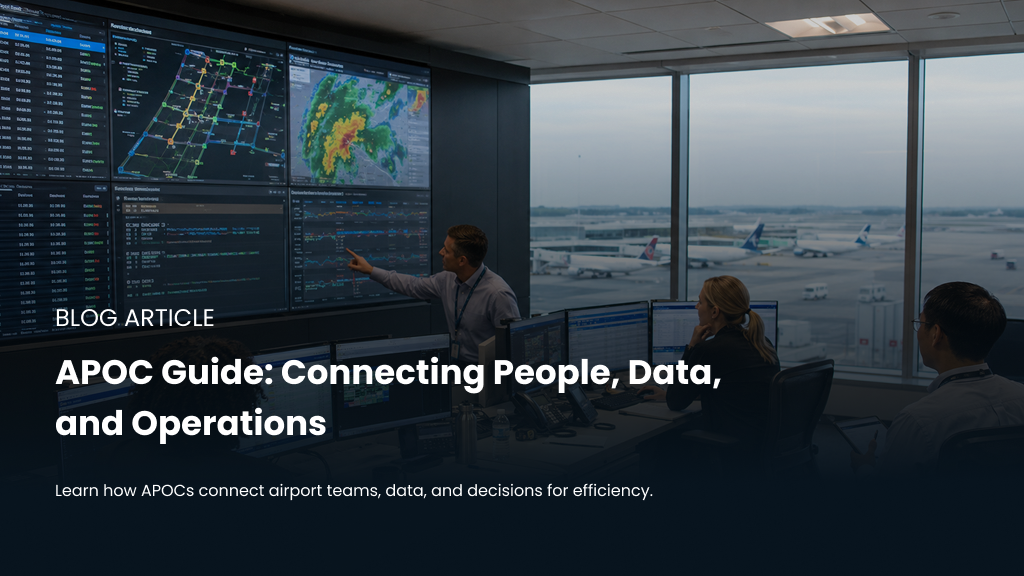
It shifts the airport from reactive troubleshooting to proactive management. According to Airports Council International (ACI) EUROPE guidelines, an APOC is defined as a structured coordination arrangement. It is not just a room with screens. It is a collaborative environment where representatives from every critical department sit together, look at the same data, and solve problems as a unified team.
Consider a winter weather scenario. In a traditional setup, the meteorological team warns air traffic control about incoming snow. Air traffic control then calls the terminal managers. The terminal managers then notify the airlines. Valuable minutes are lost during this chain of communication. In a unified operations hub, the meteorological team issues the warning, and every department sees it simultaneously on a shared dashboard. De-icing trucks prepare, airlines adjust boarding times, and terminal staff prepare holding areas; all at the exact same time.
Core Pillars of APOC
Building an effective APOC Command Centre requires more than just buying new software and hardware. It relies on three core pillars: structured decision-making, a clear daily plan, and the right physical or virtual environment.
Collaborative Decision-Making (A-CDM)
Collaborative Decision-Making (A-CDM) is a standardised operational framework that improves the efficiency and predictability of aircraft turnaround through shared milestones and collaborative decision-making. The goal is to reduce delays and minimise fuel burn by keeping everyone on the exact same schedule.
When an aircraft lands, A-CDM relies on specific, shared milestones. The most critical milestone is the Target Off-Block Time (TOBT). This metric indicates the estimated time the aircraft will be ready to leave the stand. Ground handlers, air traffic control, and airlines all share this exact data point. Eurocontrol data shows that fully implementing A-CDM can reduce taxi times by up to three minutes per flight, saving up to three million minutes of taxi time annually across European airports. For the airport, reclaiming these minutes frees up valuable gate space, allowing you to safely handle more daily flights without building expensive new infrastructure.
The Airport Operations Plan (AOP)
If A-CDM is the process, the Airport Operations Plan (AOP) is the daily roadmap. The AOP is a rolling, constantly updated schedule plan that predicts passenger flow, baggage volumes, and aircraft movements.
This plan allows the airport to exchange critical data with external networks, such as the Network Manager Operations Centre (NMOC) in Europe. Sharing your AOP with the wider network prevents regional bottlenecks. If a severe weather front moves across the continent, the AOP adjusts automatically, giving everyone in the APOC Command Centre a clear view of the new reality. It links the local airport directly to the wider global aviation network.
Space and Setup: Physical vs. Hybrid
The traditional image of an operations hub is a massive dark room filled with glowing video walls. A physical location heavily encourages face-to-face collaboration. Operators can literally look across the room, make eye contact, and resolve an issue in seconds.
However, the physical location itself matters less than the collaboration mechanism. Many airports now run highly effective virtual or hybrid command environments. Cloud-based dashboards and remote video wall controllers allow you to start modernising regional airport operations and achieve the same level of situational awareness as massive international hubs. Whether physical or virtual, the space must allow operators to access the same data and make prompt decisions together.
Key Stakeholders in the Command Centre
An APOC Command Centre only works when the right people have a seat at the table. Removing the physical walls between these groups cuts response times drastically during severe weather, security events, or system outages.
Here are the essential teams that must be involved:
Airside Operations for Runway and Taxiway Safety
These teams monitor runway conditions, taxiway congestion, and aircraft routing. They are the first to know if a runway needs clearing or if lighting systems require urgent maintenance.
Terminal Operations to Manage Passenger Flow
This group tracks passenger flow from the front door to the boarding gate. They monitor queue lengths at security, check-in desks, and passport control. Airports Council International data shows that efficient passenger processing correlates directly with higher non-aeronautical revenue; informed passengers spend more time and money in retail areas.
Security and Police for Rapid Incident Response
Rapid response relies on instant communication. Having security personnel in the room ensures they can deploy officers the moment an issue arises, preventing minor incidents from becoming major disruptions.
Ground Handlers to Protect Turnaround Milestones
These teams manage baggage loading, refuelling, and catering. They are crucial for hitting those A-CDM turnaround milestones. A delay in baggage loading directly impacts the Target Off-Block Time.
Airline Representatives and Gate Allocation Planners
Airline representatives need to know exactly when their planes can arrive and depart. Gate planners must adjust assignments instantly if a flight is delayed, ensuring arriving aircraft always have an open stand.
Maintenance and IT Support for Critical Infrastructure
When a baggage belt breaks or a passenger information screen fails, maintenance teams need immediate dispatch orders to fix the infrastructure before it causes a passenger bottleneck.
Choosing the Right Systems for Your Operations
A key factor to remember when choosing any airport system is cross-system integration. Rather than replacing the systems you already have in place, modern setups use intelligent software to pull data from established infrastructure into a single, unified view.
Your systems must communicate flawlessly. Shared dashboards should display real-time metrics on passenger wait times, aircraft locations, and baggage handling speeds. Software that relies on open Application Programming Interfaces (APIs) ensures that data flows freely between different department systems without hitting a technical wall.
Forecasting models are another critical technological component. These tools use historical data and machine learning to predict exactly when the terminal will hit peak capacity. Demand-Capacity Balancing (DCB) tools take this a step further. These tools compare the expected number of passengers and flights against the airport’s actual physical capacity. If the system predicts a bottleneck at security in two hours, the operations team can open extra lanes before the passengers even arrive. This proactive approach completely eliminates the stress of reactive crowd control.
Security goes beyond the physical terminal. Because the operations hub acts as the central nervous system of the airport, it processes immense amounts of sensitive data. Cybersecurity must be a foundational element of your airport systems. Ransomware attacks or system breaches can blind an airport in seconds. Therefore, your software must feature end-to-end encryption, strict access controls, and regular vulnerability testing. Cloud-based platforms often offer enterprise-grade security that exceeds what a local IT team can provide, ensuring that your operational data remains secure.
The Roadmap for Launching Your APOC Setup
Launching a new operational structure takes careful planning. Following a structured approach ensures your teams adapt quickly, without confusion. Moving too fast can create resistance from staff who are used to working in their traditional silos.
Map Your Established Processes
You must audit your current workflows before introducing new systems. Watch how your teams communicate during a busy Friday afternoon. Note exactly where the information slows down. You cannot automate a broken process. Mapping out your existing communication lines helps you build a system that actually supports your staff, rather than forcing them to work around poorly integrated technology.
Define Roles and Mandates
Clear governance is non-negotiable. When an unexpected crisis hits, who has the final say? Establish these rules before an incident occurs. Every person in the room needs to understand their specific mandate. If a baggage belt breaks, the terminal manager must know exactly who holds the authority to reroute the luggage. Creating a clear chain of command prevents arguments and hesitation during high-pressure situations.
Phase the Rollout
A massive overnight launch is a disaster. Follow a phased evolution. Start by bringing a few core departments, like terminal and airside operations, into the new system. Do pilots with them and observe how it goes. Allow teams to build collaborative habits. Once they are comfortable with the shared dashboards and communication protocols, you can introduce external stakeholders like airlines and ground handlers. Training is an ongoing process. Regular pilots and simulation exercises help teams adapt and practice their response to extreme weather or security events in a safe, controlled environment.
Conduct Post-Operational Reviews
The work does not stop when the final flight departs. A truly effective operational hub uses the data gathered during the day to improve tomorrow’s performance. Post-operational analysis involves reviewing the daily logs to see where predictions missed the mark. Did the security queue back up at 2:00 PM despite the forecast? Why did ground handlers miss the Target Off-Block Time on three consecutive flights? Analysing these minor failures allows your team to tweak the forecasting models and refine the Airport Operations Plan continuously.
Conclusion
A high-performing APOC Command Centre relies on collaboration first and systems second. Putting everyone in the same room fails if teams lack a common goal and clear communication protocols. Mapping your workflows, establishing distinct roles, and adopting unified data platforms builds a single operational picture. When your stakeholders trust the data and each other, your airport navigates daily challenges smoothly and safely.
Looking ahead, the role of the APOC will become even more critical as passenger volumes climb. The command centres of the near future will lean heavily on predictive forecasting and automated capacity balancing to catch bottlenecks hours before they occur. Setting up a strong, collaborative foundation today ensures your airport is ready to adopt the advanced predictive tools of tomorrow.
Unify your command centre operations with integrated, real-time management solutions like AFIDS, ALDIS, and FIDSNet from Airport Information Systems.