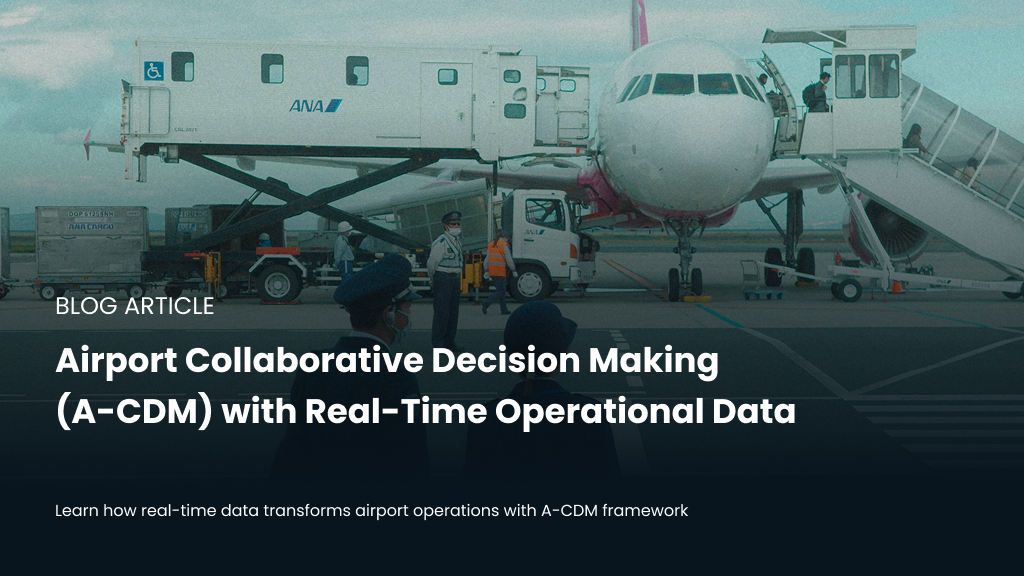
The modern airport is a high-pressure environment where every second has a price tag. As flight volumes increase and environmental targets become stricter, airport authorities must find new ways to manage their resources. The most effective framework for this is Airport Collaborative Decision Making (A-CDM).
This framework allows airports, airlines, and ground handlers to work as a single unit rather than a collection of separate businesses. However, the success of this system depends entirely on the quality of the data flowing through it. When an airport uses real-time operational data, it stops reacting to problems and starts preventing them.
This shift from guesswork to precision is what defines a world-class aviation hub.
But it comes down to why this shift is so vital, what truly sets a high-performing hub apart, and how moving from simply holding data to actually using it defines the modern airfield. Let’s find out!
The Silo Syndrome: The High Cost of Fragmented Airport Data
In many airports, departments operate within their own “silos.” This means the air traffic controllers have one set of data, the ground handlers have another, and the airlines have a third. This lack of shared information creates a massive operational challenge. When these groups do not communicate with each other through a unified system, the result is “Silo Syndrome.” This leads to a constant state of confusion that hits the bottom line.
The scale of this challenge is significant. Even with an industry-wide technology spend of $50.8 billion in 2025, data fragmentation remains a major bottleneck.
Fragmented data causes a ripple effect of delays. For instance, if a ground crew is not notified that a flight is arriving ten minutes early, the aircraft sits on the taxiway with its engines running. This wastes expensive aviation fuel and creates unnecessary carbon emissions. According to industry data, even a few extra minutes of taxi time per flight can result in significant annual costs for a medium-sized airport. These are not just small errors; they are major financial leaks that occur when the right people do not have the right information at the right time.
The “Turnaround Time” (TAT) is the most critical window in an airport’s schedule. It involves cleaning, refuelling, loading baggage, and boarding passengers. If the ground handler is working off a different schedule than the airport authority, the entire process slows down. This “whisper game” between stakeholders leads to gate conflicts and missed departure slots. When an airport loses a departure slot, it isn’t just one plane that is late; the schedule for the rest of the day is often ruined.
This fragmentation makes it impossible to achieve the high levels of predictability required in modern aviation.
Decoding A-CDM: More Than Just a Protocol
To fix these issues, the industry developed Airport Collaborative Decision Making (A-CDM). While it sounds like a complex technical term, the concept is quite simple. It is a way for all stakeholders to share their data transparently so that everyone has a clear view of what is happening on the airfield. It is a move away from individual interests toward a shared goal of operational efficiency.
The 16 Milestones of Flight
The foundation of Airport Collaborative Decision Making (A-CDM) is built on 16 specific milestones. These represent the key stages of a flight, from the initial flight plan to the moment the wheels leave the ground. In a standard operation, these milestones are often recorded in isolation. In an A-CDM environment, all partners share every milestone in real-time. This creates a “Common Situational Awareness.” Everyone sees the same flight status, the same delays, and the same opportunities for improvement.
Implementing A-CDM is as much about people as it is about technology. It requires a culture where airlines and ground handlers are willing to share their operational data with the airport authority. In the past, this data was often guarded as a trade secret. However, the industry now understands that transparency helps everyone.
When a ground handler shares an accurate “Target Off-Block Time” (TOBT), it allows the air traffic controllers to plan the runway sequence more effectively. This cooperation reduces stress for staff and improves the experience for passengers.
The Catalyst: How Data Precision Transforms Airport Operations
A plan is only as good as the information behind it. For Airport Collaborative Decision Making (A-CDM) to work, that information needs to be live. This shift changes your perspective, moving you away from tracking what has already happened and giving you a clear view of the airfield as it stands right now.
Moving from Reactive to Proactive Planning
Most airport problems are solved after they happen. This is reactive management. With high-quality operational data, airport managers can see a bottleneck forming long before it becomes a crisis. For example, if several flights are arriving early, the system can flag a potential gate shortage 45 minutes in advance. This allows the operations team to reassign stands or alert ground crews before the planes even land. Proactive planning is the only way to maintain a smooth flow of traffic during peak hours.
Optimising Runway and Stand Capacity
Runways and gates are the most limited resources at any airport. Every minute a gate sits empty when a plane is waiting for it is a wasted opportunity. Real-time data allows for “tighter” scheduling. If the system knows exactly when a plane is vacating a stand, the operations team directs the next aircraft there without delay. This increases the throughput of the airport, allowing it to handle more flights by making the most of every existing resource.
Environmental and Economic Gains
Fuel saving is a direct result of better data. When the Tower knows a flight will be ready for pushback at a specific second, they can time the engine start perfectly. This prevents aircraft from idling at the gate or in a long queue at the runway. Reducing engine run-time by even three minutes per flight leads to a massive reduction in the airport’s carbon footprint. This is a win-win for airport decision-makers: it lowers costs for the airlines and helps the airport meet its sustainability targets.
The Source of Truth: Integrating the AIS Product Suite
Data does not create value on its own; collective and organised data creates a value for it.
To run a successful Airport Collaborative Decision Making (A-CDM) programme, an airport needs a reliable technical foundation. The AIS product suite acts as this “Single Source of Truth,” connecting the airfield directly to the finance office, the passenger terminal, and other stakeholders of an airport. These tools solve real problems for airport teams without the need for a massive or disruptive IT project.
ALDIS: Automating Revenue Throughout the Airport
Finance and operations are often treated as two separate worlds, but the Airport Landing Dues Information System (ALDIS) bridges this gap. It is a proven billing system trusted by over 30 airports to automate revenue collection. It removes the risk of manual errors by accurately tracking landing, parking, and ground service fees, according to global ICAO standards. Since it integrates directly with finance tools like Sage and SAP, ALDIS ensures faster invoicing and provides clear, Excel-ready reports. This allows airport leaders to manage performance and cash flow with total confidence.
AFIDS: The Engine Behind Real-Time Accuracy
The Airport Flight Information Display System (AFIDS) acts as the eyes and ears of the airport. It gathers every bit of flight data as it happens, storing and sharing information in real-time, which optimises the entire operation. This live data feeds directly into the ALDIS billing system, ensuring every invoice perfectly matches the activity on the airfield. AFIDS also handles on-the-spot cash invoicing and tells FIDSnet exactly what to show on the terminal screens. Capturing everything in the moment ensures that your operations, your finance team, and your passengers are always in sync.
FIDSnet: Translating Operational Data for the Terminal
FIDSnet is essentially the “voice” of the airport terminal. It takes complex data and turns it into clear information about gate changes, check-in desks, and baggage belts. Designed to be budget-friendly for regional hubs, it runs on standard Android TVs or even existing screens via small Smart Boxes. You have total control over the look, matching fonts and colours to your airport’s branding. It can even push live flight updates directly to your airport website, so passengers stay informed before they even leave home. This level of clarity is a vital part of a successful Airport Collaborative Decision Making (A-CDM) strategy, as it keeps the terminal moving smoothly.
Integrating these systems ensures that operational milestones and financial records remain perfectly aligned across the airfield. It provides the practical foundation required to turn the concept of A-CDM into a daily operational reality.
Roadmap to Readiness: Making Your Airport A-CDM Compliance
Becoming A-CDM compliant is a strategic journey that requires careful planning. For an airport authority, the goal is to create a system that is robust enough to handle data from many different sources but simple enough for everyone to use.
Prioritising System Interoperability
The most important technical requirement for Airport Collaborative Decision Making (A-CDM) is interoperability. This means your software must be able to “talk” to the systems used by Eurocontrol, local air traffic services, and various airlines. Airport leaders should look for “highly configurable” software. Every airport has a unique layout and different local rules. You need a system that can be adjusted to fit your specific needs without requiring expensive custom coding every time a change is made.
Securing Stakeholder Buy-In
The success of Airport Collaborative Decision Making (A-CDM) depends on full participation from every partner on the airfield. This transition works best when it is framed as a shared victory rather than a set of new rules. For instance, ground handlers can manage their staff more effectively when they have reliable arrival times. Similarly, airlines see a direct drop in fuel costs as taxi times decrease. When the value of shared data becomes visible to everyone, the cultural shift toward transparency happens naturally.
Step-by-Step Implementation
You do not need to implement all 16 milestones on day one. Most successful airports start with a “Light A-CDM” approach. This involves focusing on the most critical data points, such as the Estimated Off-Block Time (EOBT) and the Target Off-Block Time (TOBT). Once these are shared accurately and the stakeholders see the results, the airport can gradually add more complex milestones. This steady approach reduces risk and allows the team to learn as they go.
Conclusion
In the past, an airport could get by with manual logs and radio calls. Those days are gone. As the sky becomes more crowded, the only way to maintain safety and efficiency is through the smart use of data. Airport Collaborative Decision Making (A-CDM) has become the global standard because of its proven framework. It turns the chaotic “Silo Syndrome” into a streamlined, predictable operation that benefits everyone involved.
Switching to a data-led airfield isn’t just a technical upgrade; it is how an airport stays reliable as the industry grows. By using live information to fuel their decisions, airport authorities can reduce delays, save fuel, and increase their overall capacity. This leads to a more profitable airport and a better experience for the millions of people who fly every day.
The gap between the data you have and the data you need can be bridged with the right partnership. Tools like AFIDS, ALDIS, and FIDSnet integrate to create a seamless flow of information from the runway to the boardroom. The future of airport operation belongs to the airports that choose to collaborate and manage data efficiently.
If you are ready to see how our AIS suite can support your goals and simplify your operations: