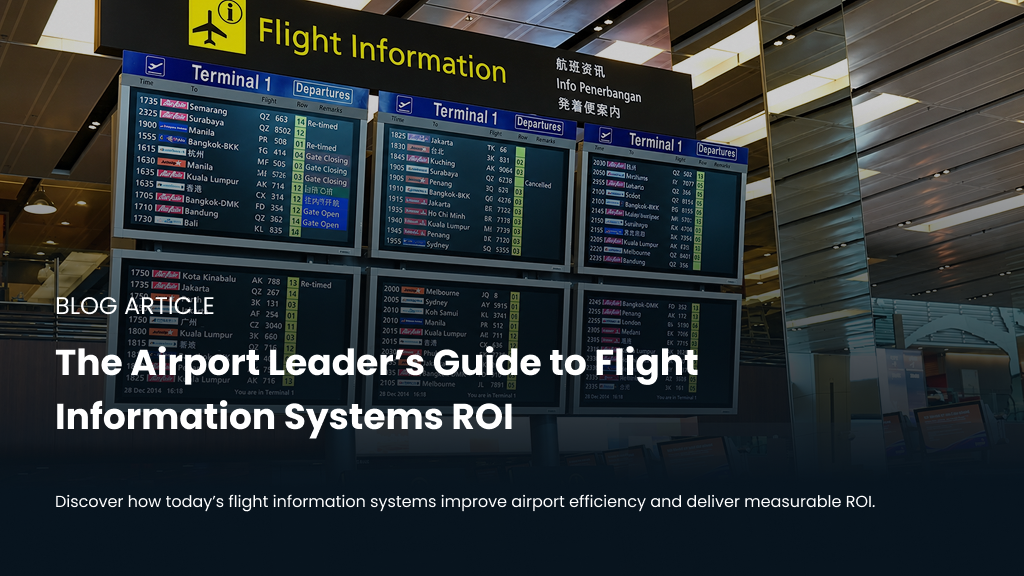
Imagine a Tuesday morning at your busiest terminal. Weather delays are stacking up, gate changes are happening every ten minutes, and thousands of passengers are looking for answers. If your flight information screens lack live, synchronised updates, you face more than just frustrated travellers. You face lost retail sales, overwhelmed ground staff, and delayed departures. Securing budget approval for new airport displays means proving the exact financial return to your CFO. To build a strong business case, you must accurately calculate your flight information systems ROI.
When gate changes happen quickly, and passengers cannot find clear updates, airports lose money. Every minute a traveller spends searching for information is a minute they spend away from your shops and cafes.
Industry data shows exactly what is at stake. The Airports Council International (ACI) reports that non-aeronautical revenue makes up nearly 36.7% of global airport income. Meanwhile, Eurocontrol estimates that network delays cost an average of €100 per minute in Europe. Accurate, real-time data displays directly improve both of these crucial numbers.
However, many executives still view display screens as a basic cost rather than an investment. They see the initial hardware price and installation fees, but they miss the daily operational savings. Here is how to build a reliable calculator for your new system and prove its true financial value to your airport’s bottom line.
How Fragmented Flight Data Drains Airport Revenue?
Before calculating the return on a new system, you must understand the cost of keeping your current setup. Older systems rely heavily on manual input and disjointed data sources. When a gate change occurs, a staff member often has to type the update into a separate terminal. This creates a critical time lag.
During this data gap, passengers consume inaccurate information. They inevitably flood your information desks and form queues at the boarding gates. This creates bottlenecks in high-traffic concourses and spikes terminal-wide anxiety. To prevent this, successful hubs rely on Airport Collaborative Decision Making (A-CDM) backed by Real-Time Operational Data to ensure all departments and display screens share a single source of truth instantly.
These hidden inefficiencies compound rapidly. Instead of deploying staff as customer service experts, the budget is wasted paying them to act as manual data entry clerks. Retail revenue drops significantly because anxious travellers refuse to leave the gate area to visit concessions. Furthermore, the airport faces severe financial penalties when aircraft miss their takeoff slots due to late-boarding passengers.
Why a Modern Flight Information System is an Investment, not a Cost?
We often view screens and display software as a basic operational expense. You buy the hardware, plug it in, and expect it to last for five to ten years. However, treating these systems as simple expenses hides their true financial potential.
Current systems change terminal dynamics completely. They integrate directly with an Airport Operational Database (AODB). This direct link means every screen in your terminal updates automatically the second a flight status changes. No manual entry is required at the gate.
This automation turns your display network into a revenue-generating asset. When a system actively reduces staffing hours and boosts retail spend, it pays for itself. The screens stop being just hardware and start acting as a vital communication tool that drives passenger behaviour.
To measure this effectively, you must track specific financial metrics. Calculating your flight information system ROI requires looking past the initial price tag. You must look at the daily, monthly, and yearly savings the software creates across your entire airport infrastructure.
The Four Pillars of Your ROI Calculator
Building a credible business case requires data. You cannot just promise that things will get better; you must show exactly where the money comes from. Focus your calculations on these four specific areas.
1. Retail and Non-Aeronautical Revenue
Passenger anxiety is the enemy of retail sales. When travellers do not know their gate number or boarding time, they wait directly at the gate. They do not sit in restaurants, and they do not browse duty-free shops. They hold onto their wallets and watch the desk.
Clear, real-time flight updates reduce this anxiety. Passengers who trust the screens feel relaxed. Relaxed passengers have longer dwell times in commercial zones. Retail studies suggest that passengers spend an average of $7 for every hour they wait in a terminal, but this retail spend drops by 30% if they feel stressed or stuck in lines.
A strong flight information system ROI calculation must include this retail uplift. If better screens give 10,000 passengers an extra 15 minutes of relaxed dwell time each day, your retail concessionaires will see significantly higher foot traffic. Even a conservative 1% or 2% increase in food and retail spend adds up to millions over a full financial year.
Furthermore, you can use these modern screens for targeted advertising. Digital signage campaigns allow you to sell screen time to local brands, airlines, or terminal shops. You can show duty-free promotions right next to the departure times. This creates a direct, measurable stream of income that feeds straight into your flight information system ROI.
2. Staffing and Resource Optimisation
Labour is one of your highest operating costs. Look at how many hours your information desk staff, security personnel, and gate agents spend answering the exact same question: “Is my flight delayed?”
When your screens show accurate, easy-to-read data in multiple languages, passengers do not need to ask staff for help. They check the nearest monitor and move on. This frees up your team to handle complex issues, like rebooking missed connections or assisting passengers with reduced mobility.
Centralised, automated data means you need fewer people managing the information flow across different terminals. To factor this into your flight information system ROI, calculate the hours saved. If your team saves 30 hours a day on manual updates and passenger queries, multiply those 30 hours by the average hourly wage. That number is a direct daily savings. Over a year, this wage optimisation represents a massive return on your initial software investment.
3. Reducing Avoidable Delays
Unclear gate information leads to late passengers. Late passengers delay departures. Every single minute of delay costs the airport and the airlines money. Missing baggage removal, runway slot penalties, and extra fuel burn add up incredibly quickly.
As mentioned earlier, Eurocontrol data shows that network delays can cost an average of €100 per minute. A clear, highly visible display network guides passengers to their gates on time. It improves your overall on-time performance (OTP).
When calculating your flight information system ROI, look at your current delay metrics. How many flights leave late simply because passengers could not find the gate? If clear signage can reduce passenger-related delays by just two minutes per flight, calculate that financial savings across your entire daily flight schedule. The financial impact of keeping aeroplanes moving on time is massive. Airlines will also favour your airport if you consistently help them maintain their schedules, making your airport more competitive.
4. Lowering Maintenance and Print Costs
Managing physical updates and printed signs is expensive. If a boarding zone changes, a staff member must print a new sign, walk it over, and tape it up. If an older local server crashes, your IT team must drop everything to fix it, often paying rush fees for replacement parts.
Current cloud-based setups remove the need for expensive on-site servers. You do not need to pay for dedicated IT staff to run and maintain massive hardware racks in a back room. A cloud system lowers your daily energy consumption and drastically reduces the time spent fixing broken hardware.
Add your yearly print costs, server maintenance fees, energy bills, and hardware replacement budgets together. Subtract the yearly cost of a modern cloud software subscription. The difference gives you another solid figure to include in your flight information system ROI equation.
Building Your ROI Formula
You now know where the financial savings come from. Next, you must put these numbers into a formula that your CFO and finance team will easily accept.
The framework is straightforward: Total Financial Benefit minus Total Investment.
First, calculate your total financial benefit for the year. Add up your projected retail revenue increase, your staffing wage savings, your delay reduction savings, and your lower maintenance costs. Make sure you use actual airport data to inform these estimates.
Second, calculate your total investment. Add up the cost of the new display hardware, the software licensing fees, the installation labour, and any staff training costs.
Subtract the total investment from the total benefit. This gives you your net return. To find the exact flight information system ROI percentage, divide the net return by the total investment cost, and then multiply that number by 100.
For example, if the system saves you £500,000 a year across retail, staffing, and maintenance, and it costs £200,000 to purchase and install, your net return is £300,000. That gives you an ROI of 150% in the very first year. Use conservative estimates when building this case. Even with low estimates, the financial return of a modern setup is usually very resourceful.
Making the Final Business Case
Stakeholders and board members want to see how this technology supports the airport’s main goals. Presenting a strong flight information system ROI means linking these financial metrics directly to high-level airport priorities.
Address terminal safety as a core operational benefit. Clear screens prevent overcrowding in narrow corridors. They keep passenger flow smooth and prevent panic during severe weather delays.
Demonstrate the direct link to commercial profitability. Show them the ACI data on non-aeronautical revenue. Explain how giving passengers back 10 minutes of their time translates directly into coffee, magazine, and duty-free sales. Use your ROI formula to show exactly how much new revenue you expect to generate.
Show them the math on staffing. Explain that you are not necessarily cutting jobs, but rather moving your staff from repetitive, frustrating tasks to high-value customer service roles. This improves staff morale and reduces expensive employee turnover rates.
When you present a complete, well-researched calculation, you completely change the conversation. You stop asking for a budget to buy screens. You start offering a proven, data-backed strategy to increase the airport’s overall profit and efficiency.
Conclusion
Upgrading your display network creates a direct path to higher airport revenue and smoother daily operations. When you track the specific metrics that matter, like retail spend uplift, staffing hours saved, and reduced departure delays, the financial return becomes incredibly clear. A solid flight information system ROI calculator provides the hard data you need to build a compelling business case and secure executive approval.
Looking ahead, terminal screens will continue to evolve from basic flight boards into smart systems that actively predict congestion and guide the entire passenger journey. Preparing for this shift requires flexible, highly responsive technology.
The AIS product suite delivers the exact real-time synchronisation and data accuracy your airport needs to drive immediate financial returns and easily adapt to future aviation trends.
Looking to simplify your airport operations? Discover how Airport Information Systems can work alongside you to bring that vision to life.