- AI in Airport Operations: The Shift from Prototype to Production
- Where AI is Making the Biggest Operational Impact in Airports?
- Data Integration: The Real Challenge Behind the Scenes
- AI in airport operations 2026: What Airport Leaders should focus on now?
- Trust, Transparency, and the Human Factor
- Conclusion
- FAQs
Airport leaders today face a complex reality: passenger numbers are surging, expectations for service are higher than ever, and operational budgets remain constrained amidst ongoing staff shortages. The core systems managing daily operations are robust but must now handle unprecedented volumes and complexity. For years, technology upgrades promised relief. Most delivered dashboards, alerts, and more data, but not always better decisions. In 2026, AI in airport operations is beginning to shift that balance.
Artificial intelligence is no longer sitting on the side as an analytics add-on. It is becoming part of how airports plan, predict, and respond in real time. Not in bold pilot projects or glossy demo labs, but in everyday operational decisions.
This shift matters because airports are complex systems. One delay ripples across gates, ground handling, baggage, security, and passenger experience within minutes. The newest wave of AI tools is built for exactly this kind of complexity.
Let’s take a closer look at AI in airport operations, what is genuinely working in 2026, and where decision-makers are focusing next.
AI in Airport Operations: The Shift from Prototype to Production
A few years ago, AI conversations in aviation were heavy on ambition and light on results. Most pilots were small, isolated, and hard to scale. AI-led operations were only initial Prototypes, testing Proof of Concepts (PoC)
That has changed.
Today’s AI systems are no longer built as standalone tools. They sit inside airport operations, learning from live data such as flight movements, passenger flows, weather updates, CCTV feeds, and asset performance logs.
The biggest change in 2026 is not smarter algorithms. It’s better integration.
Airports are now seeing AI as a decision support layer, not a replacement for operational control. This shift has made adoption easier and results more consistent.
Where AI is Making the Biggest Operational Impact in Airports?
AI is now embedded in day-to-day airport operations, supporting decisions that affect flow, cost, safety, and service quality. The biggest gains are appearing in areas where timing, coordination, and visibility matter most.
The sections below look at where airports are seeing practical value today, focusing on use cases that improve predictability, reduce disruption, and support experienced teams rather than replace them.
Passenger Experience and Terminal Flow
Passenger flow shapes almost every part of airport performance. When queues build, pressure spreads quickly across security, retail, and gate operations.
In practice, airports are now using predictive queue monitoring to redeploy staff before lines grow, biometric lanes to reduce repeated document checks, and digital assistants to redirect passengers away from congested areas. Together, these tools help airports manage flow proactively, keeping terminals moving even during peak periods.
Managing passenger flow has always been one of the most complex challenges in airport operations. Traditional planning relies on schedules, historical averages, and manual observation. These methods work, but they respond to congestion after it has already started.
Predicting congestion in advance
Modern systems analyse live inputs such as flight arrivals, security throughput, border control processing times, and local traffic conditions. Instead of showing where queues exist, they predict where congestion is likely to build in the next 20 to 40 minutes. This allows teams to act earlier and avoid reactive firefighting.
Some platforms now push this horizon much further. For instance, ASTRA (AI-Enabled Tactical FMP Hotspot Prediction and Resolution) is an AI-based decision support system that uses multiple machine learning models to identify 4D Areas of Relatively High Air Traffic Control Complexity (4DARHAC) up to 20 minutes in advance, and in some cases up to one hour. Beyond detection, ASTRA also proposes resolution strategies, giving operations teams time to adjust staffing, flows, or sequencing before congestion becomes visible on the terminal floor.
Fast-track processing through biometrics
Biometric passenger processing, when supported by cloud-based platforms, reduces repeated identity checks at key touchpoints. The benefit is not just speed, but consistency. Passengers move through terminals with fewer interruptions, while staff deal with fewer exceptions.
Accessible travel guide
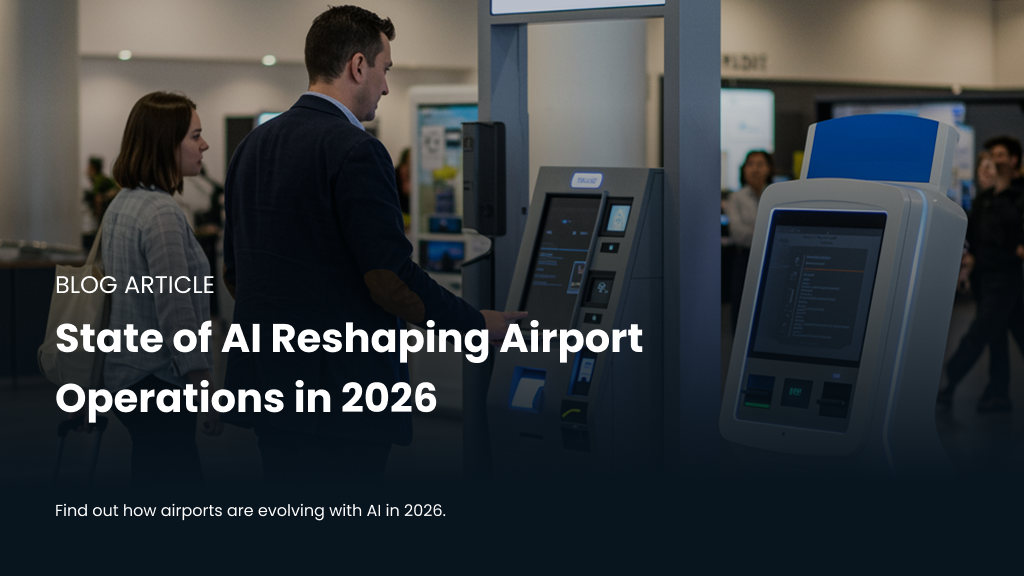
AI chatbots and virtual assistants now provide round-the-clock information through airport apps, kiosks, and websites. These tools handle routine questions about gates, delays, baggage, and facilities, reducing pressure on service desks and keeping passengers informed without adding staffing strain.
AI-powered systems are already answering a large share of common travel enquiries, such as flight status and gate changes, helping to relieve operational bottlenecks without queues forming at desks. Real-time AI communication tools can respond instantly across thousands of simultaneous interactions, reducing wait times and freeing human agents to focus on complex or urgent cases.
According to industry projections, around 42% of airports were considering AI-powered chatbot services as part of customer support offerings, reflecting widespread adoption of this technology for passenger assistance.
Operational Control and Decision-Making
Airport operations depend on many parties moving in sync, often across different systems and priorities. What is changing is not decision ownership, but visibility and timing. Live operational data is now combined, analysed, and surfaced as early signals, allowing teams to see conflicts, delays, and resource pressure before they become operational problems. This earlier awareness gives operations managers time to coordinate actions across airlines, ground handling, and air traffic services, rather than reacting once disruption is already underway.
Stronger collaborative decisions through AI-enhanced A-CDM
Airport Collaborative Decision Making has long aimed to improve coordination between stakeholders. AI strengthens this by analysing live operational data and highlighting risks earlier. Small delays that might once have gone unnoticed are now flagged before they escalate into wider disruption.
Airport Collaborative Decision Making, or A-CDM, links airlines, ground handlers, and air traffic control. AI makes it sharper by crunching data on weather, fuel, and readiness.
A practical example is Assaia’s ApronAI, deployed at airports including Munich Airport. The system monitors aircraft turnarounds in real time and alerts teams to potential delays before they occur, supporting better coordination across ground handling and departure sequencing. Airports using this approach report improvements in on-time performance and turnaround reliability.
Predicting delays and their knock-on effects
Predictive delay analytics use machine learning trained on historical and real-time aviation data. These systems do more than forecast delays; they estimate how a late flight might affect gates, connections, crew availability, and runway capacity. This lets operations teams prioritise actions that reduce overall disruption rather than chasing individual flights.
Machine learning models can analyse vast datasets, including flight history, weather, aircraft rotation, and operational events, to forecast likely delay patterns with much higher accuracy than traditional methods. For instance, research applying machine learning to flight data at a busy airport in Dhaka showed models like CatBoost and XGBoost could predict flight delays with up to 95 % accuracy, helping planners prepare more reliable schedules and resource allocations.
These kinds of predictive insights help airports and carriers see “ripples” before they happen, so teams can adjust gates, staffing, or sequencing early and keep operations steadier throughout the day.
Testing decisions using digital twins
Digital twins create a live virtual model of airport operations that mirrors real-time data from systems such as flight information, building management, passenger flow, and ground services. AI and machine learning models are applied within these twins to simulate scenarios, for example, testing the impact of stand changes, queue adjustments or service lane openings before any action is taken in the real world. This helps planners see outcomes, trade-offs and risk points without disrupting current operations.
A real example of this technology in use is Sydney Airport’s smart twin, which connects siloed operational data into a unified model. The airport reported annual savings of about AU$1 million after using the digital twin to improve collaboration, reduce inefficiencies, and test operational changes in a virtual environment rather than in live operations.
Asset, Baggage, and Infrastructure Intelligence
Airports rely on complex systems that run almost continuously. When equipment fails, recovery is costly and visible to passengers. AI in Airport Operations supports maintenance and baggage operations by identifying issues early and improving response speed when problems occur.
Preventing failures through predictive maintenance
Airport assets operate continuously under high load. AI-driven predictive maintenance analyses sensor data and performance trends to identify early signs of failure. Maintenance teams receive alerts before breakdowns occur, allowing work to be scheduled during planned windows instead of peak operations.
Improving baggage handling visibility
AI-driven analytics and advanced tracking are increasingly used to boost visibility across baggage operations. These tools monitor conveyor performance, detect jams or unusual movement early, and give operations teams faster insight into where bags are and how systems are performing, helping reduce delays and passenger complaints.
Industry data shows that smarter tracking and handling systems are correlated with a lower rate of mishandled baggage globally. According to SITA’s 2025 Baggage IT Insights report, the global mishandling rate fell to 6.3 bags per 1,000 passengers in 2024, down from 6.9 the year before, which is a steady decline tied to investments in automation, better tracking and information sharing across stakeholders. Over 66 % of mishandled bags were resolved within 48 hours, highlighting the operational benefits of improved visibility and integrated systems.
RFID and similar technologies, widely adopted across airlines and airports, support this trend by giving handlers and operators near-real-time status for luggage from check-in through arrival. A survey of 155 airlines and 94 airports found that 44 % of carriers had fully implemented baggage tracking systems, with another 41 % underway, enabling better coordination and confidence that bags will be found and routed correctly.
These technologies reduce dependence on manual checks and allow staff to concentrate on exceptions instead of routine tracking, improving reliability without increasing operational workload.
Sustainability and Cost Efficiency
Energy use and emissions are now board-level concerns, driven by rising costs, regulatory pressure, and long-term net-zero targets. In practice, airports are using data-driven optimisation to understand how terminals are actually used throughout the day and adjust systems accordingly. By linking passenger movement, occupancy sensors, weather data, and building controls, these tools reduce energy waste during low-demand periods while maintaining comfort when volumes rise. The emphasis is on extracting more value from existing infrastructure rather than relying on large-scale capital upgrades.
Optimised Energy use across terminals
AI systems are increasingly used to manage heating, cooling, and lighting based on passenger volumes, time of day, occupancy, and weather conditions. Instead of fixed schedules, these systems adjust energy use in real time, reducing waste while maintaining passenger comfort.
Across large facilities, AI-driven building management platforms typically deliver 15–25 % HVAC energy savings by aligning operations with actual usage rather than assumptions. Airports are also using sensors and analytics to fine-tune ventilation and lighting in low-traffic areas, supporting sustainability goals without adding operational complexity.
Airports also combine smart sensing with control systems to reduce waste. For example, Vancouver International Airport’s sustainability programme uses CO₂ sensors to adjust HVAC operations to actual passenger presence and has upgraded lighting and chilled water systems to reduce overall energy loads.
Better commercial forecasting without pressure selling
AI-driven forecasting supports retail planning by analysing dwell time, passenger profiles, and purchasing trends.
Airports use this insight to make better layout, staffing, and inventory planning decisions, such as what products to stock, where to place them, and when to replenish. Revenue grows more steadily without relying on aggressive personalisation or intrusive sales tactics, helping protect passenger trust.
Safety and Security
Security in aviation remains a human-led responsibility. AI supports this work by improving visibility and consistency, especially in busy terminals. Used carefully, it helps staff focus attention where it matters most, without changing the passenger experience.
Reducing Screening Fatigue While Improving Detection
Security screening places sustained cognitive load on officers, especially during peak waves when thousands of bags and images must be assessed in short time windows. Fatigue increases risk, not because staff are unskilled, but because human attention has limits, under repetition and pressure.
AI-supported screening systems are designed to reduce this load. At Frankfurt Airport, the Automatic Prohibited-Item Detection System (APIDS) combines AI software with Smiths Detection CT scanners, allowing passengers to keep their cabin bags closed during screening. The system automatically identifies potential threats such as knives, firearms, and detonators, flagging only suspicious items for secondary inspection.
According to Alexander Laukenmann, early data demonstrates a 12 to 15 percent rise in lane throughput during peak morning hours, coupled with a decrease in false alarms. Officers retain full decision authority while spending less time on routine clears and more time on genuine security assessments.
Improving situational awareness in terminals
Behavioural anomaly detection tools analyse movement patterns to flag unusual activity. These systems provide alerts for review by trained staff rather than making automated judgments. When used correctly, they enhance awareness without creating an intrusive environment for passengers.
Data Integration: The Real Challenge Behind the Scenes
Despite the progress of AI in airport operations, one issue continues to limit AI’s impact at many airports: data integration.
Airport operations are run on a mixed environment of existing platforms, vendor-supplied systems, and custom tools. Data often sits in silos, owned by different stakeholders with different priorities. AI systems depend on clean, reliable, and timely data. Without it, even the best models struggle.
Airports seeing the strongest results from AI share a few common traits:
- They invest early in data quality and standardisation
- They prioritise integration over experimentation
- They start with narrow, high-impact use cases
AI can highlight gaps, inconsistencies, and errors in operational data, but it cannot fix them on its own.
Airports that see real value from AI usually strengthen data governance and architecture before expanding their use.
AI in airport operations 2026: What Airport Leaders should focus on now?
In 2026, success with AI is not about being first. It is about being deliberate.
Airport leaders should focus on:
- Clear operational problems rather than technology trends
- Tools that support operational judgement, not replace human decision-making
- Vendors who understand airport operations, not just software
- Training and change management alongside deployment
Small, well-executed implementations often deliver more value than large, ambitious programmes that struggle to scale.
Trust, Transparency, and the Human Factor
One lesson appears again and again across airports that have adopted AI successfully.
People matter more than technology.
Frontline staff need to understand how AI tools work, what they do, and where their limits lie. Systems that explain why a recommendation is made build trust far faster than black-box solutions.
Human override remains essential. AI performs best when it supports judgment, not when it tries to replace it.
Airports that treat AI as a partner rather than an authority see better adoption, better outcomes, and fewer cultural barriers.
Conclusion
AI is no longer changing airports in dramatic, visible ways. It is changing them quietly, steadily, and from the inside out.
In 2026, the airports benefiting most from AI are not those chasing the latest tools. They are the ones using AI to remove friction, reduce uncertainty, and support better decisions under pressure.
The future of airport operations is not automated. It is assisted, informed, and human-led.