- Showcasing Innovation at the Synergex Conference
- Modernising AFIDS 2.0: Modern Tech Without Interrupting Airport Operations
- Building Our Harmony Core Migration Strategy for Modernising AFIDS
- Overcoming Challenges in Modernising AFIDS
- The Results: Scalable, Agile, and Future‑Ready Systems
- Demonstrating Real‑World Performance Improvements
- Conclusion
- FAQs
When the aviation industry talks about digital transformation, the discussion often circles around new platforms and technologies. But behind every innovation lies a quiet story of engineering transformation. This year, at the Synergex Conference, we shared ours. A story about bridging decades of excellence with the power of modern architecture to modernise AFIDS 2.0.
For Airport Information Systems (AIS), the mission has always been clear: build intelligent, reliable, and scalable software that keeps airports running smoothly. Yet, as airport operations evolve, even well‑established systems get to a point where they need thoughtful modernisation to keep pace with new demands, technologies, and user expectations.
That moment came for us with the decision to migrate from traditional Synergy DBL environments to the Harmony Core web services framework. The shift has not only elevated our performance and scalability but also enabled us to facilitate smooth integration across modern ecosystems.
Showcasing Innovation at the Synergex Conference
Our Synergex DevPartner Conference session was far more than a technical walkthrough. We discussed why modernisation must balance innovation with continuity, especially for mission-critical airport systems.
During the session, Kuldeep Singh, Staff Technical Specialist at AIS, walked through how the team approached modernisation without disrupting live airport operations. The focus was not on visual upgrades alone, but on creating a web-first architecture that could coexist with established systems already trusted by airports worldwide.
Attendees saw how our move to Harmony Core strengthens our API strategy, broadens integration capabilities, and sets a new standard for long-term scalability.
Modernising AFIDS 2.0: Modern Tech Without Interrupting Airport Operations
AIS has been building airport systems since 1986. Over that time, their applications have become deeply embedded in daily airport operations worldwide.
These systems support:
- Flight data management across landside and airside
- Aeronautical billing and cash invoicing for visiting aircraft
- Long-term planning, reporting, and historical analysis
- Passenger-facing flight information displays
The existing desktop architecture, built on the Synergy Toolkit with Infragistics controls, provided a stable, single-threaded environment for decades. However, as the industry shifted, the transition from this ‘stateful’ desktop model to a ‘stateless’ web-based architecture required deep analysis. The goal was to modernise the delivery without sacrificing the high-performance ISAM (Indexed Sequential Access Method) file structures that ensure 24/7 reliability in high-pressure airport environments.
In practice, this reflects how AIS software operates within airports. Rather than being a standalone application, it becomes part of the operational backbone, supporting continuous, time-critical activity.
That long-term role is a strength, but it also brings responsibility. As user expectations shift toward web-based interfaces, real-time dashboards, and API-driven integration, any change must be approached with care.
Building Our Harmony Core Migration Strategy for Modernising AFIDS
Modernising complex enterprise software isn’t a switch you flip overnight; it’s a structured journey.
A major driver behind the strategy was the need to avoid a “big bang” rewrite. AIS systems support continuous airport activities, including flight movements, invoicing, and operational coordination, which cannot pause for redevelopment.
Harmony Core enabled a bridge approach: retaining high-performance ISAM data structures while exposing them through modern RESTful APIs. This allowed AIS to evolve the architecture incrementally, rather than replacing it outright.
Before committing to production development, the team spent close to three months on discovery and proof-of-concept work. This phase validated API performance, examined how system components interacted, and confirmed that the new architecture could scale without compromising stability.
Based on these findings, AIS adopted a phased migration strategy focused on incremental progress and business continuity, ensuring each step could be delivered and validated without disrupting live airport operations.
A critical component of this strategy was Harmony Core’s Traditional Bridge. By leveraging Synergex’s CodeGen (Code Generation) open-source tool, we automated the creation of much of this bridge code, which significantly reduced manual effort and allowed our developers to focus on higher-level architecture rather than repetitive ‘boilerplate’ tasks.
Next came the Proof of Concept (POC), a critical checkpoint where we validated Harmony Core’s fit within our environment. The POC allowed us to test APIs, assess performance, and identify how the framework could co-exist with legacy layers during transition.
Once validated, we executed a step-by-step migration plan. Each milestone had built-in regression checks and fallback mechanisms. This methodical planning ensured minimal business disruption, a critical factor given the operational sensitivity of airport systems.
Overcoming Challenges in Modernising AFIDS
Modernisation is rarely frictionless. Our work on modernising AFIDS surfaced several real‑world engineering challenges, each one teaching us something valuable.
1. Managing dynamic configuration updates
Tightly integrated systems often carry deeply embedded dependencies. We needed an architecture that could support flexible updates without breaking critical workflows. Harmony Core’s service-based approach helped us achieve that, enabling real-time configuration without disrupting operations.
In established desktop-style applications, configuration changes are often tightly coupled to system state. Moving to a web-based model required AIS to redesign how configuration data was stored and accessed, ensuring updates could be applied dynamically without affecting active operations.
2. Decoupling long-standing components
Over time, many APIs and operational modules became closely interconnected. Refactoring them required careful decomposition to isolate reusable business logic while introducing Synergex’s Harmony Core–based services and avoiding conflicts when multiple web requests accessed the same data.
3. Balancing transformation with ongoing business needs
Airports operate continuously, and the systems supporting them must do the same. To modernise without affecting daily operations, AIS adopted a dual-track approach that allowed innovation to progress alongside uninterrupted service delivery, with each milestone supported by regression testing and fallback paths to protect live environments.
4. Sharing lessons for the industry
We made a point to capture every key insight and process milestone, not just for internal use but to help guide other organisations embarking on similar modernisation paths. Collaboration and knowledge-sharing are at the heart of our digital culture.
5. Rethinking State Management for Web-Based Architecture
This transition required a fundamental shift in how we handle statelessness. In the old world, the application ‘remembered’ a user’s session state locally; in the web world, we had to refactor our business logic so that every REST API call from the Harmony Core layer contained all the information needed to execute the request independently.
The Results: Scalable, Agile, and Future‑Ready Systems
The results of modernising AFIDS with Harmony Core have been measurable: technically, operationally, and strategically.
Smarter Integrations and Faster Performance
Our systems now operate in a connected environment designed for today’s API-first world. Integrations with external systems, including flight data services and airport management platforms, are now both faster and more dependable.
By exposing core functionality through APIs, AIS systems can now integrate more easily with external airport platforms, analytics tools, and third-party services, without custom point-to-point connections.
Scaling AFIDS 2.0 for Busy, Data‑Driven Airports
The updated architecture supports flexible scaling as airports demand deeper, data-driven insight. It handles seasonal traffic surges and integrates smoothly with connected devices across the terminal.
Delivering Quicker Intuitive User Experience
The architecture also supports modern front-end frameworks. By adopting React and Next.js, AIS delivers faster, more responsive interfaces while keeping the underlying operational logic unchanged.
Future-ready foundation
The work of modernising AFIDS goes beyond a simple upgrade; it’s a long-term investment in the platform. We’ve built a technology base that allows for continuous improvement, agile development, and rapid delivery of new capabilities to our airport clients.
Operational resilience
Despite significant underlying changes, our migration process ensured zero downtime during critical operations, a key validation of our phased, controlled migration design.
Beyond just connectivity, the migration enabled us to adopt JWT-based authentication for modernised security and SQL replication. By moving data into SQL environments in real-time, we unlocked the ability to embed Power BI dashboards directly onto the user’s home screen, providing instant visual insights into airport trends that were previously locked behind static reports.
Demonstrating Real‑World Performance Improvements
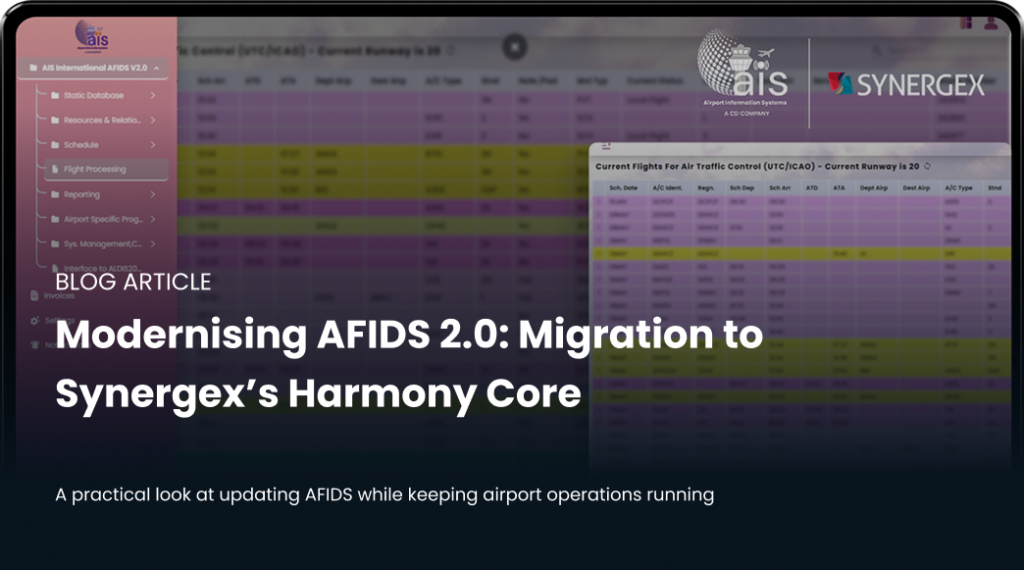
At the Synergex DevPartner Conference, we showcased a side-by-side comparison of our existing application and its re-engineered Harmony Core equivalent.
The contrast was clear:
- System responsiveness improved significantly with reduced latency.
- API calls processed faster, enhancing data flow between systems.
- User interfaces became more consistent, thanks to decoupled front-end logic.
- Architectural simplicity made maintenance and feature development more straightforward.
The visual transformation was most evident in Flight Strips and other operational screens. Using a React and Next.js frontend, AIS introduced a Single-Page Application (SPA) experience with Role-based Access Controls (RBAC) and dynamic menus, all powered by the same Harmony Core APIs. Even existing screens can now be tailored by role, allowing operational staff to focus on real-time decisions while administrators move directly to financial and planning views without navigating multiple screens.
Data replication into SQL environments also made it possible to integrate tools like Power BI, giving airports real-time dashboards with charts and trends directly on their home screens.
More than a technical transformation, the demo showed what’s possible when proven systems meet forward‑thinking engineering.
Conclusion
Every modernisation journey is, at its core, about staying relevant and resilient. For Airport Information Systems, modernising AFIDS with Harmony Core has been a defining step — one that empowers us to innovate, adapt, and continue supporting airports with reliable, future‑ready information systems.
From an airport’s perspective, the outcome feels like a modern, newly delivered system. Behind the scenes, AIS has preserved decades of operational knowledge and reliability, now delivered through a more adaptable and connected architecture.
The journey doesn’t end here. We’re actively exploring new ways to extend integration capabilities, enhance automation, and further strengthen our digital architecture across our product set. As we move forward, collaboration with our partners and clients will continue to shape how airports connect, operate, and evolve.
Ultimately, this journey was about preserving the ‘gold’ within our 35 years of business logic while providing a ‘web-first’ experience that, as many clients noted, feels like a completely new system. It wasn’t about starting over; it was about giving our proven reliability a modern voice.
To hear the full technical story from our team, watch Kuldeep Singh’s Synergex DevPartner Conference session “Modernizing AFIDS Application with Harmony Core.”
Want to experience how AIS modernises airport systems without disruption?